01. The legal front
A new ActA new Act ties data processing to a named purpose and consent — with penalties to ₹250 crore.
INDIA • DPDPA 2023 • T−363d
— INDIA • DPDPA 2023 • T−363 days
~70% of large transformations fail.*About 7 out of 10 large transformations fail.*
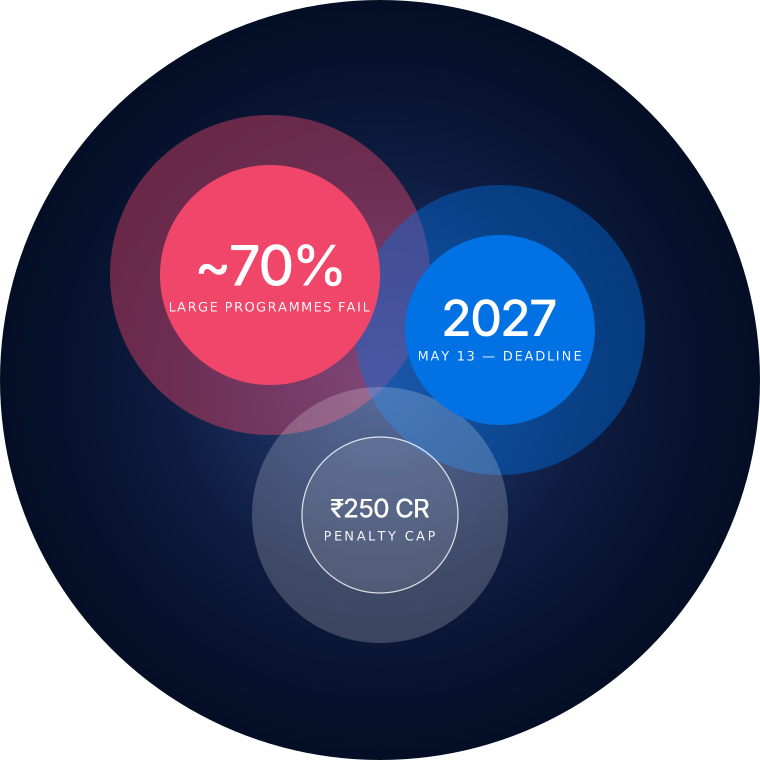
— The Transformations
Each is enterprise-wide and continuous. None can be sequenced.
01. The legal front
A new ActA new Act ties data processing to a named purpose and consent — with penalties to ₹250 crore.
02. The technical front
A new architectureThe Act demands controls on every system handling personal data — across the enterprise and its vendors.
03. The AI front
A new paceAI delivers the programme on time — and itself becomes something the Act must govern.
— The 70% problem
What McKinsey, BCG, and HBR agree on
All studied large transformations. The findings are similar.
— 7 DPDPA patterns
Visible in surveys, embedded in systems and integrations. The cost of unwinding compounds toward May 2027.
Enterprise complexity compounds across transformations; it does not dissolve. DPDPA inherits the regulatory and technical layers an SDF has accumulated over decades, and AI now adds a new layer. The seven patterns that follow are predictable not because the subject is simple, but because the structural conditions — layered systems, layered governance, a fixed deadline — keep producing the same shapes.
Survey-based records cannot evidence the systems the regulator examines. Inaccurate RoPA caps every dependent control — DPIA, breach response, children's data.
Without one governed source of truth — systems, vendors, data categories, regulations — DPDPA collides with RBI, SEBI, IRDAI, and tax retention floors team by team.
A vendor portal captures the request. Fulfilling it means reading, updating or deleting personal data across every system the enterprise and its vendors operate.
Capturing consent is solved. Starting and stopping processing as consent changes — across every operational system — is where most programmes stop short.
Security safeguards, audits, breach response — each is handed to a different tech team. The shared foundation beneath them is presumed in place — and rarely built as one.
Most teams still discover data by survey and build software by waterfall — methods too slow for a deadline that will not move.
DPDPA's penalties are board-scale — yet boards delegate the work as a compliance project and review it monthly. An owner accountable for the whole is rarely named.
Without knowing where data actually lives and flows, every dependent control breaks. Gap assessment is guessing. Reference data is free-text. DPIA is fiction. Consent management is UI theatre. Rights fulfilment is a treasure hunt. Discovery by survey is decay. Security is guarding the vault while copies float downstream. Breach response is damage control in the dark. Ownership is mistaken for attendance.

— The Solution
The product builds the architectural foundation — an engineer- and AI-verified data flow map — from which DPDPA capabilities inherit.
The advisory keeps each capability anchored to the foundation, under one technical-first owner. Together: shorter calendar, lower cost, and compliance as a reusable asset rather than recurring overhead.
Both pillars are easy to describe. The case study below shows them delivered.
— The case study
Inside one of India’s largest banks: two consulting engagements produced months of documents but no defensible foundation. A few strategic inputs across legal, tech, AI, and cost course-corrected the programme within weeks. Crores saved across integrations, vendors, and teams.
— The Product
Compliance foundation software. Lightweight armour for India’s heaviest data regulation — built once, holds up under what follows.
One unified design — simple enough for business, legal, and technical teams to use together. The data flow map is the RoPA — engineer- and AI-verified, kept in step with the systems where personal data lives rather than reconstructed once a year.
What the foundation answers
Every smaller penalty in the Act — one source, one audit trail.
† Mithril — a fictional metal from J.R.R. Tolkien’s The Lord of the Rings — light as silk, strong as steel. Hence MithrilMap: a lightweight architecture that withstands DPDPA’s heaviest demands.
— The Strategy

Most Significant Data Fiduciaries meet DPDPA as fragmented procurement — each function buys its own piece, and no one owns the whole. A unified strategy treats it as one designed programme instead: the Act read as engineering work, every provision placed across the enterprise's functions under a single accountable owner.
The leverage is in the diagnosis — one cross-cutting reading of the problem does the work that fragmentation splits across many engagements. And a programme designed once, rather than procured in parts, lifts profit from both sides: it cuts cost, and it keeps the bank's data lawfully earning.
— Capabilities
Nine capabilities, all read from one verified foundation. They run the length of DPDPA — from the ₹250-crore security provision to the everyday data-principal request — and each holds up under audit because the foundation beneath it does.
Evidence reasonable security at rest, in transit, and in use across every system the map records — the Act's ₹250-crore exposure.
Compute the blast radius in hours, not weeks — principals affected, fields exposed — to meet the 72-hour notification clock.
Flag children's data wherever it flows and hold it to the Act's stricter limits — verifiable parental consent, no behavioural tracking.
Read an audit-ready Record of Processing Activities off the maintained map — not a survey reassembled once a year.
Run the annual Data Protection Impact Assessment on real flows and live controls, not questionnaire answers.
Give the independent auditor and the Data Protection Board a standing evidence trail, not one assembled each cycle.
Fulfil access, correction, and erasure where personal data actually lives — across every system that holds it, inside the enterprise and out.
Carry consent — granted, reviewed, updated — from the capture point into every system that processes the data.
Answer each grievance with full lineage — what data, under which consent, through which systems, under what controls.
— The Founder
A decade in global finance, books in print, companies founded — and an engineer's training from IIT Bombay beneath it all. Through every one of them runs a single habit of mind: thinking in systems.
Whether you are a Data Fiduciary or Data Processor weighing your compliance posture, a consulting firm exploring co-delivery, or a vendor evaluating partnership — a few lines by email, and Anil replies personally.
We typically respond within one business day.
Your email is your consent — to MithrilMap using your details for the purpose you state, and nothing else. This site does not use cookies or tracking.